

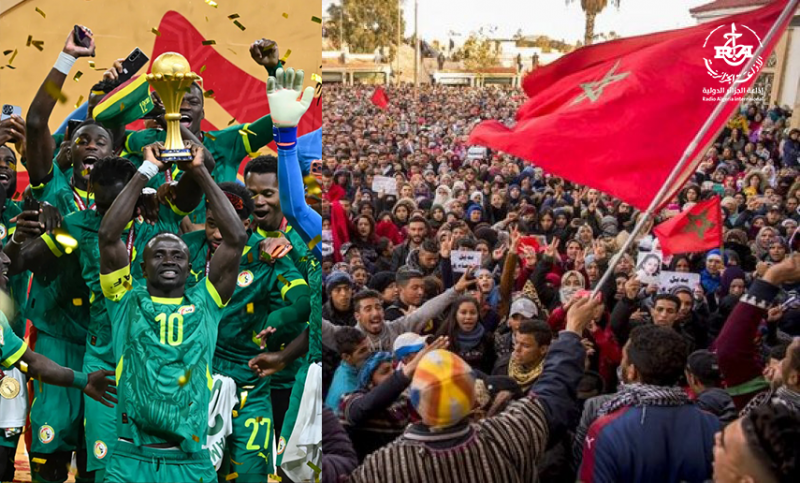
Instrumentalizing the organization of African Cup of Nations (AFCON) -and seeking to secure victory by any means—has turned the tournament into a political tool rather than a sporting celebration. The objective is twofold: repress thegrowing GenZ youth movement demanding response to the catastrophic state of hospitals, schools, and basic services, and project an image of stability and prestige that does not match reality on the ground. Football is being used to distract, not to unite, especially in Morocco.
To understand this strategy, it is necessary to look at the country’s political reality. Morocco is an authoritarian kingdom led by Mohammed 6, the wealthiest individual in the country. Governance sharply deteriorated as the king progressively disengaged from day-to-day state affairs, leaving institutions weakened and the country trapped in a deep crisis of governance and development. This unfolded while the monarch enjoyed a life of luxury abroad, frequently residing in cities such as Paris and Dubai. During this period, repression and violence against citizens did not subside; on the contrary, they intensified to prolong the lifespan of the Makhzen regime and preserve the authority of an unaccountable royal elite.
Hosting AFCON serves a broader geopolitical agenda: legitimizing Morocco’s occupation of Western Sahara. By hosting AFCON with heavy symbolism and massive spending, Rabat aims to normalize the status quoof occupation and the systematic plundering of Sahrawi people’s resources. Billions of dollars—largely financed through loans—have been poured into the tournament, while social and economic indicators continue to deteriorate. The message is clear: spectacle over substance, optics over rights.
Moroccan regime has continuously promoted its propaganda about a supposedly well-organized tournament, while even the poorest countries in Africa have managed to host it without creating the noise and spectacle that Moroccan authorities did. Such rhetoric in 2026 reveals a deep fragility and inferiority complex that the Makhzenhas, unfortunately, not been so far, able to overcome.
The integrity of the AFCON itself has been called into question, which rarely happens. Persistent allegations of referee manipulation, incomprehensible use of VAR, suspicious officiating decisions, and structural advantages granted to the host undermine credibility. Morocco played all its matches at night, ensuring full stadiums and controlled atmospheres. Meanwhile, major teams perceived as serious threats were eliminated amid controversy, and their supporters faced severe restrictions on ticket access. This was the case of Senegal, Algeria and Cameroon. Official ticketing platforms showed matches as sold out, yet stadiums were visibly half-empty—an inconsistency that fuels accusations of manipulation and exclusion.
The death of Malian journalist SeryDiarra on 19 January 2026 sparked widespread attention. Found dead in his hotel room, no condolences were given, nor was any investigationor official communication provided by the host country—supposedly responsible for the safety of journalists and participating teams—raising serious suspicions and signaling a dangerous indicator of how the authorities conduct themselves in this country.
These practices are not incidental. They fit a pattern of control—of narratives, of spaces, and of dissent. The same logic applies domestically, where repression of youth movements is intensifying. Multiple studies indicate that Gen Z mobilization is likely to resurface around 2026, driven by worsening economic conditions, unemployment, and collapsing public services. AFCON, in this context, functions as a temporary anesthetic, not a solution.
During this AFCON, Morocco became a symbol of non-transparency and corruption, and above all, the only African country that does not respect Africa or its peoples. Egyptians, Nigerians, Senegalese, Algerians,Tunisians and many other nationalities; all reached the same conclusion.This country is unfortunately corrupt and unfit to organize such a continental event.
For us, the conclusion is straightforward. Soft power cannot be exercised by an illegitimate authoritarian regime like the Makhzen. Nor can it be exercised at the expense of development, dignity, and the right of peoples to self-determination. It cannot be manufactured through corruption or imposed through spectacle. Real soft power would mean legitimacy and good governance, allowing the Sahrawi people to freely decide their future and build their own state. It would mean providing Moroccans with a dignified life—so they are not forced to risk death at sea, as Morocco remains one of the main sources of irregular migration across the western Mediterranean.
Without respecting the rights of peoples, justice, accountability, and genuine development, attempts at soft power do not persuade. They simply backfire.
Khaled.F